
72. Horn Signals Explained: Short Blasts, Long Blasts, and What They Actually Mean
Your Horn Is Not Just for Emergencies
Many recreational boaters think the horn is only used to:
- warn people
- get attention
- avoid collision at the last second
That is incorrect.
Your horn is actually part of a formal communication system under the Navigation Rules.
It communicates:
- your intentions
- your movements
- warnings
- restricted visibility signals
Especially in:
- rivers
- narrow channels
- fog
- commercial traffic areas
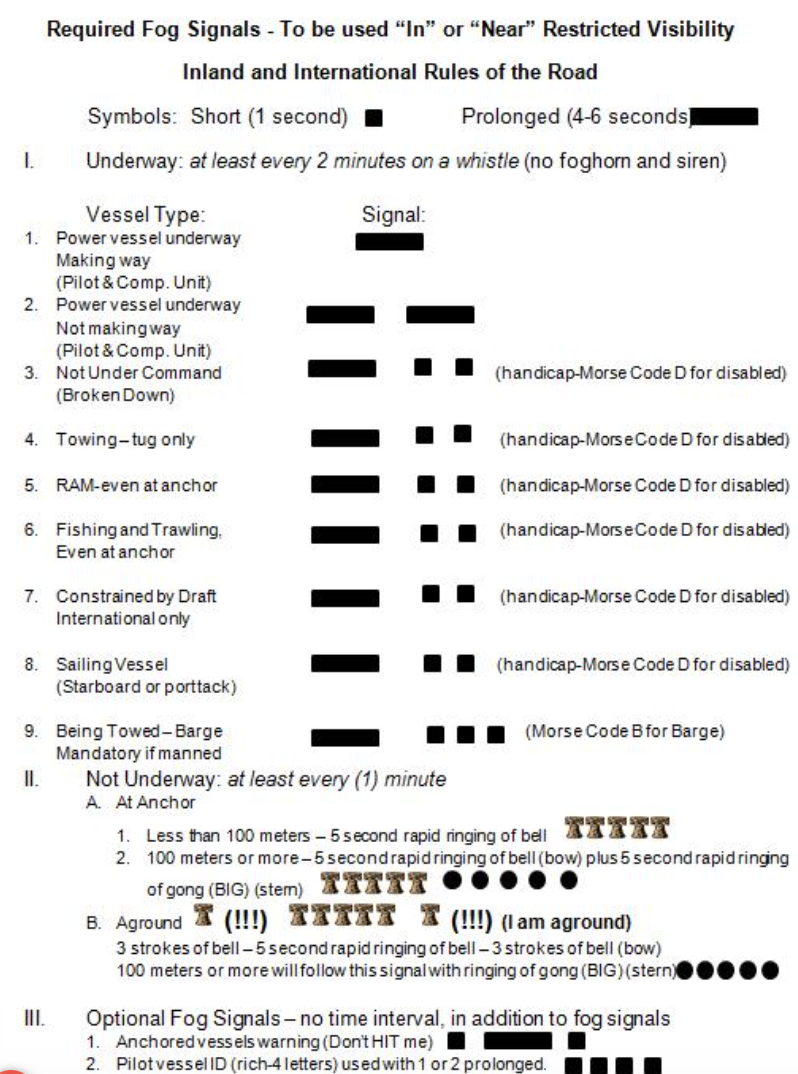
First: What Is a “Short” and “Long” Blast?
Short Blast
👉 About 1 second
Long Blast
👉 About 4–6 seconds
This matters because:
👉 the meaning changes completely depending on duration.
Maneuvering Signals (The Most Important Ones)
These are commonly used when vessels are in sight of one another.
One Short Blast
👉 “I am altering my course to starboard (right).”
Very common when:
- passing another vessel
- maneuvering in rivers
- commercial traffic situations
Two Short Blasts
👉 “I am altering my course to port (left).”
Three Short Blasts
👉 “I am operating astern propulsion.”
Meaning:
- vessel is backing up
- engines are in reverse
This is especially important in:
- marinas
- tight channels
- commercial docking situations
Danger Signal
Five Short Blasts (Rapid)
👉 “I do NOT understand your intentions”
OR
👉 “Danger!”
This is a serious warning signal.
Usually means:
- another vessel is making an unsafe move
- collision concern exists
- intentions are unclear
Restricted Visibility Signals (Fog, Heavy Rain, Low Visibility)
These are extremely important and heavily ignored by recreational boaters.
One Long Blast Every Two Minutes
👉 Power-driven vessel underway
Meaning:
- vessel is moving through the water
- visibility is restricted
Two Long Blasts Every Two Minutes
👉 Vessel underway but stopped (not making way)
Meaning:
- not anchored
- not moving through water
One Long + Two Short
Used by:
- sailing vessels
- towing vessels
- fishing vessels
- vessels restricted in ability to maneuver
This is common in commercial waterways and offshore traffic.
Why This Matters in Real Life
In rivers like:
- Hudson River
- East River
- narrow inland waterways
commercial traffic often relies heavily on:
👉 horn + VHF communication together
Especially:
- around blind bends
- under bridges
- in fog
- at night
Common Recreational Boater Mistakes
- never testing the horn
- not understanding signals
- using horn emotionally instead of properly
- failing to recognize commercial vessel intentions
Your Horn Is Required Equipment
Under U.S. Navigation Rules, vessels are required to carry an appropriate sound-producing device.
Reference:
U.S. Coast Guard Navigation Center
https://www.navcen.uscg.gov/navigation-rules-amalgamated
Real-World Example
You hear:
👉 one short blast from a tug in a narrow river
That is not random.
That tug is communicating:
👉 “I intend to alter course to starboard.”
If you don’t understand that:
👉 you may create a dangerous situation.
Final Thought
The horn is not decoration.
It is not optional.
And it is not “old-school.”
It is still one of the most important communication tools on the water.
Especially when visibility is poor, space is tight, or commercial traffic is involved.