112. What Is Credential Verification for Mariners?
In the marine industry, credentials matter — not just for compliance, but for trust, safety, and professionalism. Licenses, certifications, and training are the foundation of a mariner’s career, yet verifying them has traditionally been slow, inconsistent, and fragmented.
That’s where credential verification comes in.
So what does credential verification for mariners actually mean — and why is it becoming more important?
⚓ What Credential Verification Means (In Plain Terms)
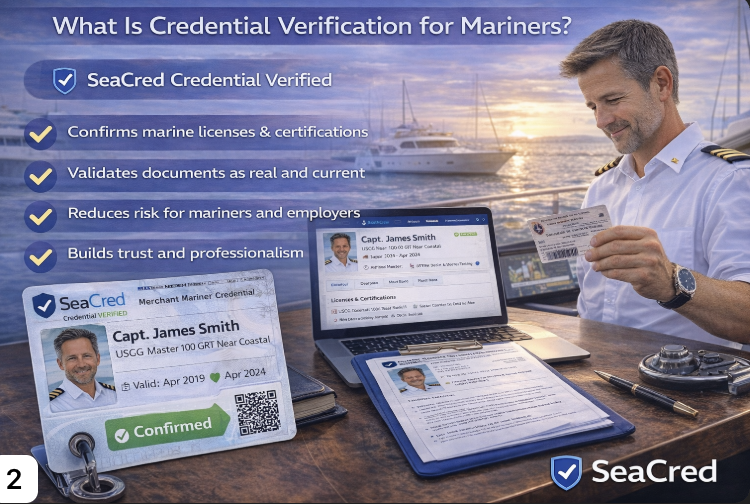
Credential verification is the process of confirming that a mariner’s licenses, certifications, and qualifications are real, current, and valid.
Instead of relying solely on:
- PDFs emailed back and forth
- Photos of documents
- Verbal claims
- Last-minute checks
Verification creates confidence upfront — for both mariners and employers.
🌊 What Typically Gets Verified
Credential verification may include confirming:
- Captain licenses and tonnage
- Endorsements (Near Coastal, Oceans, Towing, etc.)
- STCW certifications
- CPR / First Aid
- Radar, ECDIS, or specialized training
- Expiration dates and validity
The goal isn’t to judge experience — it’s to confirm authenticity.
🧭 Why Credential Verification Matters in Marine Hiring
Marine hiring involves:
- Valuable vessels
- Passenger safety
- Insurance requirements
- Regulatory compliance
Employers want reassurance that:
- A license is legitimate
- Certifications are current
- Documents haven’t expired or been altered
Verification reduces:
- Risk
- Delays
- Misunderstandings
- Last-minute cancellations
It helps hiring move faster — and with more confidence.
⚓ What Credential Verification Is Not
It’s important to clarify what verification does not mean.
Credential verification:
- ❌ Does NOT replace interviews
- ❌ Does NOT replace reference checks
- ❌ Does NOT guarantee performance
- ❌ Does NOT judge seamanship or attitude
It simply confirms that documents match claims.
Experience, professionalism, and judgment still matter most.
🌍 Why Verification Is Becoming More Common
As marine hiring becomes more digital and global:
- Employers may never meet candidates in person initially
- Work happens across borders and jurisdictions
- Timelines are tighter
- Compliance expectations are higher
Verification creates a shared baseline of trust — especially when hiring remotely or on short notice.
🧠 How Verification Benefits Mariners
For mariners, verification can:
- Reduce repeated document requests
- Eliminate skepticism about credentials
- Speed up hiring decisions
- Signal professionalism and preparedness
- Help stand out in competitive searches
It’s not about proving worth — it’s about removing friction.
⚓ Optional vs. Mandatory Verification
A key point: credential verification should be optional, not a barrier.
Strong platforms allow mariners to:
- Be visible without verification
- Choose verification if and when it adds value
- Control how credentials are shared
Verification should enhance opportunity — not restrict it.
🌊 Where SeaCred Fits In
SeaCred is designed to offer optional credential verification for mariners who want it.
It exists to:
- Validate credentials securely
- Reduce repetitive checks
- Increase trust without paywalls
- Support, not replace, professional judgment
Importantly:
- Verification is optional
- Free marine profiles remain fully functional
- Opportunity is never locked behind payment
⚓ The Bottom Line
Credential verification for mariners is about trust and efficiency, not gatekeeping.
It confirms what you’ve earned — without replacing:
- Experience
- Reputation
- References
- Judgment
Used correctly, verification strengthens marine hiring by making it clearer, faster, and more professional — while still respecting the realities of life on the water.