114. What a “Verified Captain” Really Means
The term “Verified Captain” is showing up more and more in marine hiring — but it’s also one of the most misunderstood labels in the industry.
Some assume it means “better captain.”
Others think it’s required to get hired.
And some worry it’s just another paywall in disguise.
So let’s clear it up.
Here’s what a Verified Captain really means — and just as importantly, what it doesn’t.
⚓ The Simple Definition
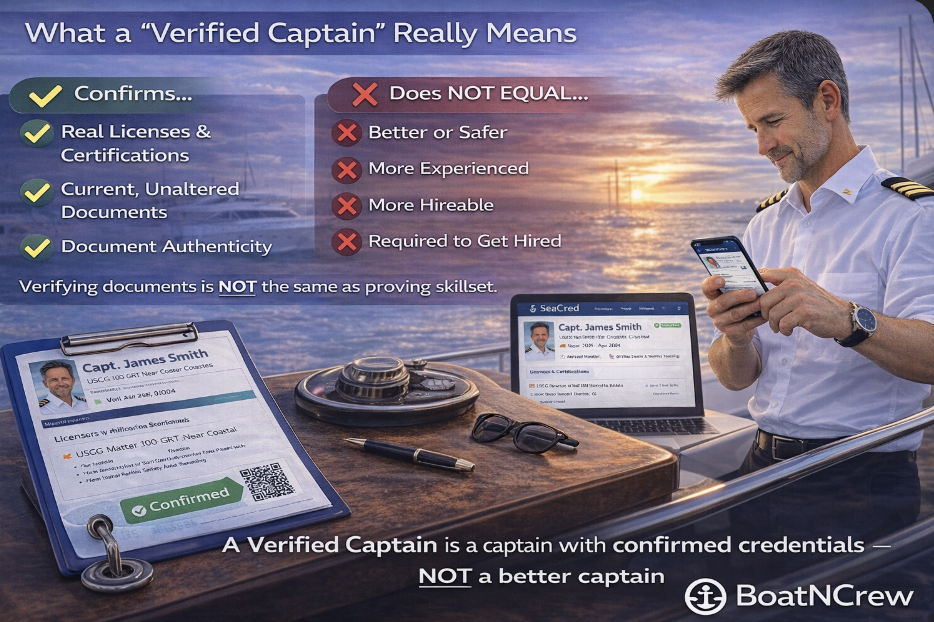
A Verified Captain is a captain whose credentials have been reviewed and confirmed to match what they claim — nothing more, nothing less.
Verification typically confirms that:
- A license exists and is legitimate
- Endorsements are real
- Certifications are current
- Documents haven’t been altered or misrepresented
It’s about document authenticity, not skill level.
🌊 What Verification Confirms — and What It Can’t
Verification can confirm paperwork.
It cannot confirm judgment.
A Verified Captain is not automatically:
- More experienced
- Safer in heavy weather
- Better with guests
- Calmer under pressure
- A stronger leader
Those qualities only reveal themselves through:
- Sea time
- References
- Interviews
- Real-world performance
Verification is administrative — seamanship is earned.
🧭 Why Verification Exists at All
Verification exists to solve a practical problem, not to rank captains.
It helps when:
- Hiring happens remotely
- Employers don’t already know the captain
- Timing is tight
- Insurance or compliance matters
- Paperwork delays slow decisions
In these cases, verification can reduce friction and speed up trust.
⚓ What a Verified Captain Is Not
A Verified Captain is not:
- A guarantee of performance
- A replacement for references
- A shortcut around interviews
- A requirement to get hired
- A signal of superiority over other captains
Any platform suggesting otherwise is overselling the concept.
🌍 Optional vs. Mandatory: The Line That Matters
The most important distinction is whether verification is optional or mandatory.
Healthy marine hiring platforms:
- Keep verification optional
- Allow captains to be visible without it
- Let experience and reputation lead
- Treat verification as an enhancement, not a gate
When verification becomes mandatory, it stops being helpful and starts becoming a barrier.
⚓ How BoatNCrew Approaches “Verified Captain” Status
On BoatNCrew, captains are never required to be verified to:
- Create a profile
- Be visible to employers
- Be contacted
- Be hired
Verification is offered separately through SeaCred for captains who want:
- Faster trust in remote hiring
- Fewer repetitive document requests
- Clear confirmation of credentials
A captain’s career is never reduced to a badge.
🧠 When Being “Verified” Can Help a Captain
Verification can be useful if you:
- Work with new employers often
- Take short-notice or delivery work
- Operate in charter or regulated environments
- Want to reduce admin back-and-forth
- Prefer credentials pre-confirmed
It’s a convenience — not a requirement.
⚓ When It Doesn’t Matter at All
Verification usually adds little value when:
- You’re hired through referrals
- Owners already know your work
- Reputation precedes you
- Hiring is relationship-based
In those cases, a phone call and references matter far more than any verification label.
🌊 The Bottom Line
A Verified Captain is simply a captain whose documents have been confirmed.
It does not mean:
- Better
- Safer
- More experienced
- More hireable
Great captains are defined by experience, judgment, and trust built over time — not by badges.
Verification should support marine hiring, not redefine it.
When kept optional and transparent, it’s a useful tool.
When treated as a requirement, it misses the point entirely.