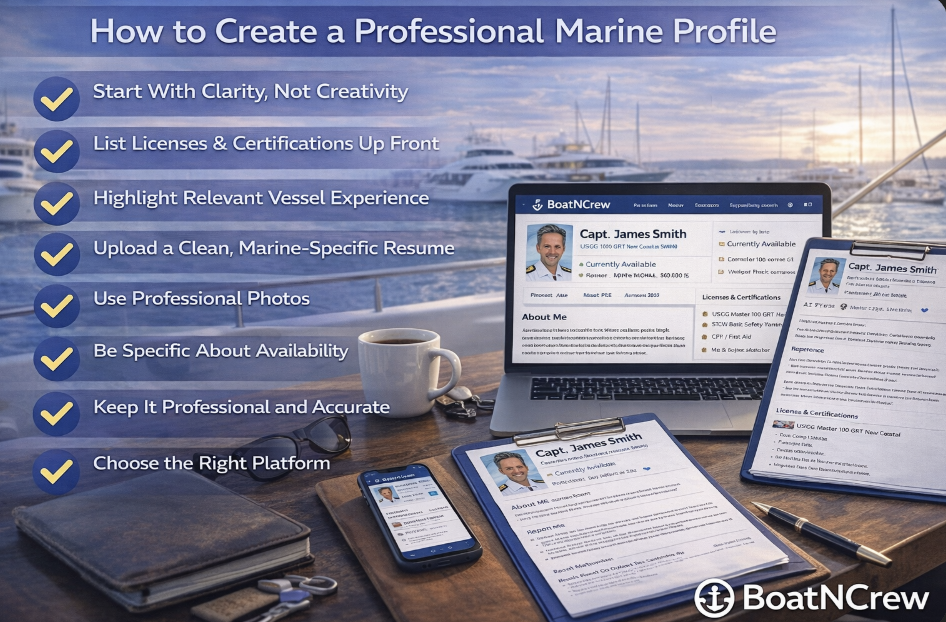
111. How to Create a Professional Marine Profile
In today’s marine job market, your first impression often happens online — long before a phone call, dockside meeting, or sea trial. A professional marine profile isn’t just a digital resume; it’s your reputation, experience, and availability presented in one clear place.
Done right, it helps employers trust you faster and hire you sooner.
Here’s how to create a professional marine profile that actually works.
⚓ 1. Start With Clarity, Not Creativity
Marine hiring values clarity over cleverness.
Your profile should immediately answer:
- What role do you fill? (Captain, Mate, Engineer, Deckhand, etc.)
- What licenses or certifications do you hold?
- What size and type of vessels have you worked on?
Avoid vague descriptions or generic bios. Employers want to understand your background in seconds, not guess at it.
🧭 2. List Licenses and Certifications Up Front
Licenses are one of the first things employers look for.
Be clear and accurate about:
- License type and tonnage
- Endorsements (Near Coastal, Oceans, Towing, etc.)
- STCW and safety training
- CPR / First Aid
- Any specialized certifications
Never exaggerate or round up — honesty builds trust faster than ambition.
🌊 3. Highlight Relevant Vessel Experience
Focus on relevant experience, not everything you’ve ever done.
Employers care about:
- Vessel size and type (motor yacht, sail, commercial, private)
- Responsibilities onboard
- Routes and operating conditions
- Progression over time
If your experience matches what they operate, they’ll keep reading.
📄 4. Upload a Clean, Marine-Specific Resume
Your profile should include a resume that:
- Is 1–2 pages
- Is clearly formatted
- Uses marine terminology correctly
- Emphasizes responsibilities and outcomes
A resume reinforces your profile and gives employers something concrete to review and save.
🧑✈️ 5. Use Professional Photos
Photos matter — not for style, but for credibility.
Best practices:
- Use clear, recent photos
- Onboard shots are ideal
- Neutral clothing or uniform preferred
- Avoid party, beach, or overly casual images
A professional photo signals professionalism before a word is read.
🕒 6. Be Honest and Specific About Availability
One of the biggest hiring delays is uncertainty around availability.
Make it clear:
- When you’re available
- Type of work you’re seeking (day work, delivery, seasonal, full-time)
- Willingness to travel or relocate
Mariners who are clear about availability get hired faster.
🔒 7. Keep Your Profile Professional and Accurate
Your profile should reflect how you operate onboard:
- Accurate dates and experience
- Realistic progression
- Professional tone
- No exaggeration or fluff
Marine hiring is reputation-driven. Profiles that feel honest and grounded build confidence immediately.
🌍 8. Choose the Right Platform
A professional profile only works if it’s seen by the right people.
Platforms like BoatNCrew are designed specifically for marine professionals, allowing:
- Free profile creation
- Visibility to real employers
- Direct communication
- No paywalls just to be seen
Where you post matters as much as what you post.
🔄 9. Keep It Updated
A stale profile can cost you opportunities.
Update your profile when you:
- Gain sea time
- Add certifications
- Change availability
- Complete a delivery or season
An updated profile signals reliability and engagement.
⚓ The Bottom Line
A professional marine profile isn’t about selling yourself — it’s about making it easy for employers to trust you.
The strongest profiles are:
- Clear
- Honest
- Organized
- Professional
- Easy to evaluate quickly
When your profile reflects how you actually work onboard, hiring becomes simpler — and faster.