126. How Employers Screen Marine Resumes — and How SeaCred Simplifies the Process
Marine employers don’t read resumes the way most people expect. They screen them — quickly, methodically, and with a strong focus on risk, readiness, and compliance.
What’s changed in recent years isn’t what employers look for — it’s how much time they have and how much certainty they expect upfront. This is where tools like SeaCred are becoming increasingly important.
Here’s how employers screen marine resumes today — and how SeaCred helps simplify and speed up that search.
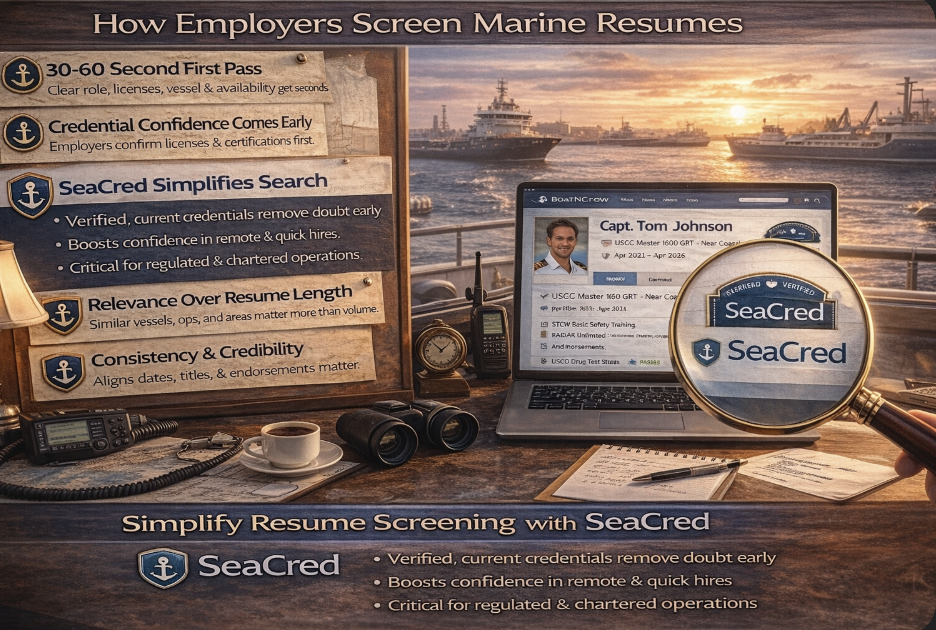
⚓ Step 1: The 30–60 Second First Pass
Most marine resumes get less than a minute on initial review.
Employers immediately scan for:
- Clear role (Captain, Mate, Deckhand, Engineer, Interior, Commercial)
- License type and tonnage
- Vessel size and type experience
- Routes or operating areas
- Current availability
If those answers aren’t obvious, the resume usually doesn’t move forward — no matter how strong the background might be.
🌊 Step 2: Credential Confidence Comes Early
Before personality, before interviews, before references — employers want baseline confidence that credentials are legitimate and current.
They’re looking to confirm:
- License level matches the vessel
- Endorsements make sense
- Certifications are valid and unexpired
- Documents align with what’s being claimed
This step often slows hiring down, especially when:
- Documents are emailed back and forth
- Files are incomplete or unclear
- Expiration dates aren’t obvious
- Hiring is remote or time-sensitive
This is exactly where SeaCred changes the equation.
🧭 How SeaCred Simplifies Resume Screening
SeaCred allows employers to separate credential verification from resume interpretation.
Instead of wondering:
- “Is this license real?”
- “Is this certificate current?”
- “Do I need to double-check this before moving forward?”
Employers can rely on verified credentials to confirm that the paperwork checks out — so they can focus on experience, fit, and judgment.
SeaCred:
- Confirms licenses and certifications
- Validates authenticity and expiration
- Reduces repeated document requests
- Speeds up early-stage confidence
It doesn’t replace resumes — it removes doubt around them.
⚓ Step 3: Relevance Over Resume Length
Once credentials feel solid, employers focus on relevant experience, not volume.
They prioritize:
- Similar vessel sizes
- Comparable operations (private, charter, commercial)
- Matching cruising grounds
- Responsibilities aligned with the role
A concise, relevant resume supported by verified credentials moves faster than a long resume that still raises questions.
🔍 Step 4: Consistency and Credibility
Employers look closely for:
- Logical career progression
- Realistic titles for vessel size
- Dates that align
- No inflated sea time or endorsements
When credentials are verified through SeaCred, employers spend less time second-guessing and more time assessing suitability.
That efficiency matters — especially when staffing gaps are costly.
🌍 Step 5: Screening Happens Inside Platforms Now
Many employers no longer screen resumes through email alone.
On BoatNCrew, employers:
- Search profiles before posting jobs
- Review resumes and experience in one place
- Compare candidates side by side
- Contact crew directly
When a profile includes SeaCred-verified credentials, employers can move forward with greater confidence — without pausing the process to verify paperwork separately.
🔒 Step 6: Verification When Timing or Risk Matters
SeaCred is especially valuable when:
- Hiring remotely
- Hiring on short notice
- Operating under charter or regulatory pressure
- Dealing with insurance or compliance reviews
Verification doesn’t replace references or interviews — it simply ensures administrative certainty early, so hiring doesn’t stall.
⚓ What SeaCred Does Not Do
SeaCred does not:
- Rank mariners
- Replace interviews
- Replace references
- Judge seamanship or character
Employers still trust experience and reputation most — SeaCred just confirms the paperwork so those judgments can happen faster.
🌊 The Bottom Line
Employers screen marine resumes by asking a few critical questions:
- Are the credentials legitimate and current?
- Does the experience match this vessel and operation?
- Is the candidate available when needed?
- Does everything feel consistent and professional?
SeaCred simplifies this process by removing credential uncertainty early, allowing employers to:
- Screen faster
- Hire with more confidence
- Reduce administrative friction
- Focus on what really matters — experience and fit
Paired with BoatNCrew’s open, professional hiring platform, SeaCred helps modern marine hiring work the way it should: clear, efficient, and trust-driven.
For employers, that means better decisions made faster.
For mariners, it means fewer barriers — and fairer consideration based on real qualifications.