123. How Commercial Crew Find Jobs Outside Agencies
For years, many commercial mariners believed agencies were the only real gateway to steady work. While agencies still have their place, a growing number of commercial crew are finding jobs independently — faster, more directly, and with greater control over their careers.
Here’s how commercial crew are successfully finding work outside agencies, and why this shift is accelerating.
⚓ Why Commercial Crew Are Looking Beyond Agencies
Agencies can be useful, but they also come with limitations that don’t always align with modern commercial operations:
- Limited job visibility
- Slow placement timelines
- Jobs filtered through third parties
- Less control over who sees your credentials
- Repeated paperwork for each placement
For crew working on tight schedules, rotating contracts, or project-based operations, these delays can mean missed opportunities.
🌊 Direct Hiring Has Become the Norm
Commercial operators increasingly prefer to:
- Search for crew directly
- Review credentials themselves
- Move quickly when vessels are short-staffed
- Hire based on availability and compliance
This applies across sectors:
- Tugs and towing
- Offshore supply vessels
- Ferries
- Workboats
- Research and survey vessels
- Commercial fishing
Direct access saves time — and time is money in commercial operations.
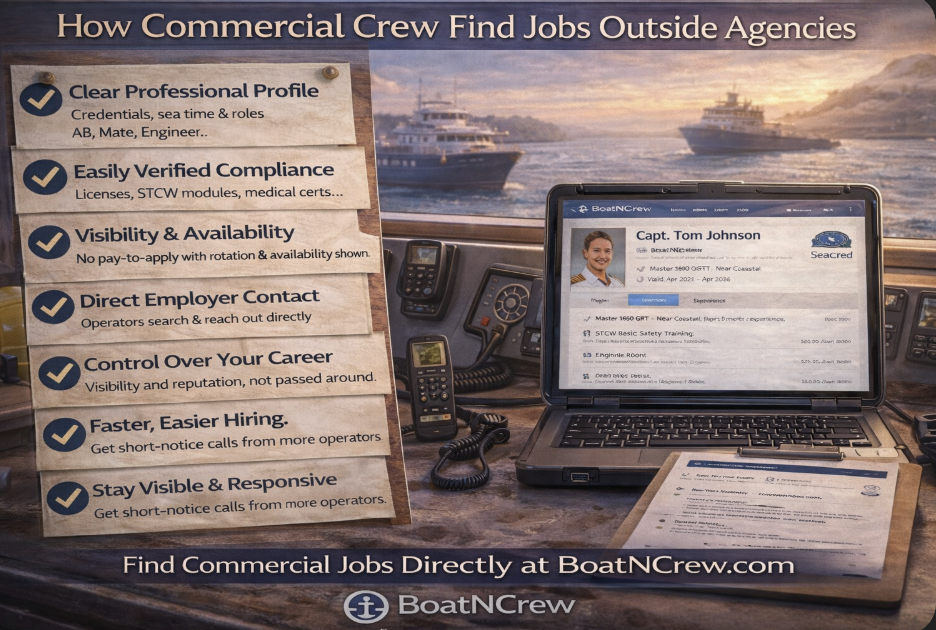
🧭 Step 1: Maintain a Clear, Professional Online Profile
The foundation of independent hiring is visibility.
Commercial crew who find work outside agencies usually have:
- A professional online profile
- Clearly listed credentials and endorsements
- Defined roles (AB, Mate, Engineer, Captain, QMED, etc.)
- Accurate sea time and vessel types
- Current availability
Platforms like BoatNCrew allow commercial mariners to present this information clearly — without paywalls just to be seen.
⚓ Step 2: Make Compliance Easy to Verify
Commercial hiring is compliance-driven.
Operators want to quickly confirm:
- License type and tonnage
- Endorsements
- STCW modules
- Medical certificates
- Drug testing status (where applicable)
Crew who keep credentials organized and up to date are hired faster — especially for relief or short-notice roles.
Optional credential verification can reduce back-and-forth, but it should always remain optional, not mandatory.
🌊 Step 3: Be Obvious About Availability
One of the biggest advantages commercial crew have is flexibility — but only if employers know it.
Strong profiles clearly state:
- Available dates
- Rotation preferences
- Geographic flexibility
- Short-term vs long-term interest
Many commercial jobs are filled quickly. Clear availability often matters as much as experience.
🧑✈️ Step 4: Let Experience Speak for Itself
Commercial hiring values:
- Reliability
- Safety mindset
- Regulatory awareness
- Teamwork
- Real-world competence
Overstating credentials or inflating roles is one of the fastest ways to lose trust.
Crew who present accurate, grounded experience are far more likely to be rehired and recommended.
🔒 Step 5: Control Your Own Career Narrative
When crew rely solely on agencies, their career is often represented by someone else.
Direct platforms allow mariners to:
- Control how credentials are presented
- Communicate directly with operators
- Build a professional reputation over time
- Avoid being passed around without context
That control becomes increasingly valuable as careers progress.
🌍 Step 6: Build Direct Relationships
Many commercial roles are filled through:
- Repeat hires
- Word-of-mouth referrals
- Operators bookmarking strong profiles
- Short-notice call-ups
Being visible online makes it easier for those relationships to form — even without an agency in the middle.
⚓ Why This Model Works Better for Many Commercial Crew
Finding work outside agencies allows crew to:
- Move faster
- Reduce admin delays
- Avoid unnecessary fees
- Access a wider range of operators
- Stay flexible across sectors
Agencies can still be useful in some cases, but they are no longer the only path.
🌊 The Bottom Line
Commercial crew don’t need agencies to build strong, reliable careers — but they do need visibility, professionalism, and readiness.
The crew who succeed independently are the ones who:
- Keep credentials current
- Present themselves clearly online
- Stay responsive
- Let experience lead the conversation
In today’s marine industry, opportunity isn’t locked behind agency desks anymore.
It’s direct, faster, and increasingly crew-driven.