117. Free vs. Paid Marine Job Platforms: What’s the Difference?
If you’re a mariner looking for work — or an employer looking to hire — you’ve probably noticed that marine job platforms fall into two camps:
- Free platforms
- Paid platforms
At first glance, it’s tempting to assume that paid means better and free means lower quality. In reality, the difference has far less to do with quality — and much more to do with how the platform is designed and who it’s designed to serve.
Let’s break down the real differences so you can decide what actually works for you.
⚓ What “Paid” Marine Job Platforms Typically Offer
Paid marine job platforms usually charge mariners through:
- Monthly or annual subscriptions
- Fees to apply for jobs
- Fees to message employers
- Fees to remain visible
Why They Charge
These platforms often rely on mariner subscriptions as their primary revenue source. Access to opportunity is tied directly to payment.
The Upside
- Smaller user pools
- Some level of spam reduction
- Predictable revenue for the platform
The Trade-Offs
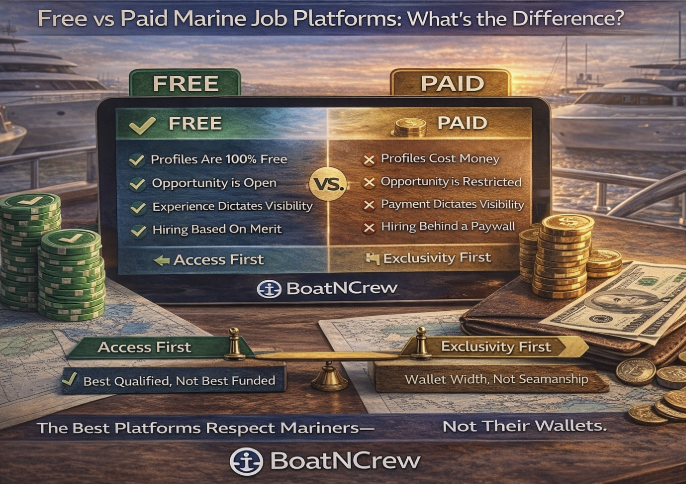
- Visibility depends on who pays, not who’s qualified
- New or freelance mariners are often excluded
- Employers see a narrower talent pool
- Opportunity becomes “pay-to-play”
Paying doesn’t make a mariner more experienced — it just keeps them in the system.
🌊 What Free Marine Job Platforms Do Differently
Free platforms remove barriers for mariners by allowing them to:
- Create profiles without payment
- Be visible to employers
- Apply for jobs freely
- Be contacted directly
The focus shifts from who pays to who is qualified.
The Upside
- Larger and more diverse talent pools
- More experienced professionals willing to participate
- Hiring decisions based on merit
- Faster connections
The Responsibility
Free platforms must rely on:
- Strong profile structure
- Clear role definitions
- Professional standards
- Optional value-added tools
When done right, free access actually improves hiring quality.
🧭 The Biggest Myth: “Paid Platforms Have Better Talent”
This is one of the most persistent misconceptions in marine hiring.
In reality:
- Great mariners exist at every career stage
- Experience is not correlated with willingness to pay
- Many seasoned captains avoid subscription platforms entirely
- Employers benefit from broader access, not smaller pools
Paid filters wallets.
Free platforms filter on experience and fit.
⚓ How Employers Experience the Difference
From an employer’s perspective:
Paid platforms often mean:
- Fewer candidates
- Repetitive profiles
- Limited availability
- Slower hiring
Free platforms often mean:
- More options
- Greater diversity of experience
- Better timing matches
- Faster conversations
Hiring works best when employers can see the full landscape, not just who paid to stay visible.
🌍 Where BoatNCrew Fits
BoatNCrew was built around a simple principle:
Mariners should never have to pay just to be seen or considered.
On BoatNCrew:
- Profiles are free for mariners
- Visibility is not tied to payment
- Employers search based on experience
- Optional professional tools exist — but are never required
Revenue comes from optional services, not from restricting access to work.
🧠 Free vs Paid Isn’t About Price — It’s About Philosophy
The real difference between free and paid platforms isn’t cost — it’s intent.
Ask yourself:
- Does the platform prioritize access or exclusivity?
- Does it reward experience or payment?
- Does it serve mariners or monetize them?
Platforms that get this right build trust, longevity, and better hiring outcomes.
⚓ The Bottom Line
Free marine job platforms are not inherently lower quality.
Paid platforms are not automatically better.
Quality comes from:
- Clear information
- Professional standards
- Honest credentials
- Direct communication
- Fair access
When opportunity is open and experience leads the way, both mariners and employers win.
The best platform isn’t the one that charges the most — it’s the one that respects the profession.