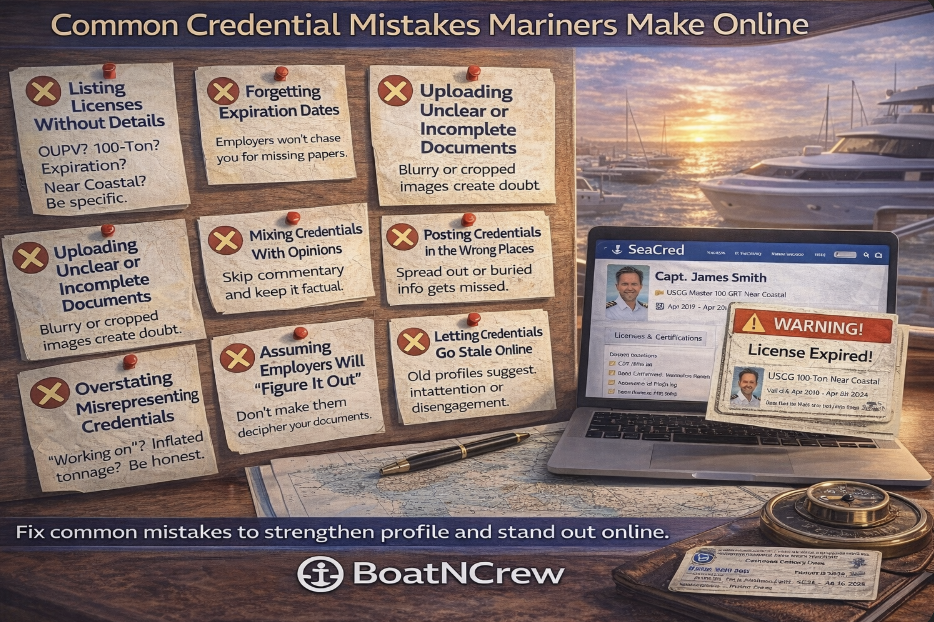
116. Common Credential Mistakes Mariners Make Online
In marine hiring, credentials are more than paperwork — they’re a signal of professionalism, readiness, and trust. Yet many capable mariners lose opportunities online not because they lack experience, but because of avoidable credential mistakes.
Here are the most common credential errors mariners make online — and how to fix them before they cost you work.
⚓ 1. Listing Licenses Without Details
Simply stating “Licensed Captain” isn’t enough.
Employers want to see:
- License type (OUPV, 100-Ton, 1600-Ton, etc.)
- Tonnage
- Route (Inland, Near Coastal, Oceans)
- Issuing authority
Missing details force employers to ask follow-up questions — and delays often mean missed opportunities.
Fix: List licenses clearly and completely, exactly as issued.
🌊 2. Forgetting Expiration Dates
Expired or soon-to-expire credentials raise immediate red flags.
Common oversights include:
- STCW modules not kept current
- CPR / First Aid expired
- Radar or medical certificates outdated
Even strong experience can be overshadowed by expired paperwork.
Fix: Keep a simple reminder system and update credentials as soon as they’re renewed.
🧭 3. Uploading Unclear or Incomplete Documents
Blurry photos, cropped screenshots, or partial uploads create doubt — even if the credential is valid.
Employers may question:
- Authenticity
- Accuracy
- Attention to detail
Fix: Upload clear, legible, full-page documents whenever possible.
⚓ 4. Overstating or Misrepresenting Credentials
This is one of the fastest ways to lose trust.
Examples include:
- Listing endorsements you’re “working on”
- Inflating tonnage or sea time
- Using informal titles that don’t match licenses
- Rounding up experience
Marine hiring is a small world. Inconsistencies are noticed quickly.
Fix: Be precise and honest. Accuracy builds far more confidence than exaggeration.
🔍 5. Mixing Credentials With Opinions or Explanations
Your credentials section should be factual — not narrative.
Avoid:
- Long explanations
- Justifications
- Personal commentary
- Excuses for gaps or limitations
Employers want clarity, not context, at this stage.
Fix: Keep credentials clean and factual. Save explanations for conversations.
🌍 6. Posting Credentials in the Wrong Places
Some mariners:
- Bury licenses deep in a bio
- Upload credentials only as images
- Leave resumes separate from profiles
- Spread information across multiple platforms inconsistently
This forces employers to piece things together — which many won’t do.
Fix: Centralize credentials in one professional profile where everything is easy to review.
Platforms like BoatNCrew are designed for this clarity.
🧠 7. Assuming Employers Will “Figure It Out”
Employers are busy. They don’t want to decode credentials or guess at equivalencies.
If something isn’t obvious, it may be skipped.
Fix: Make it easy. Clear formatting and complete information reduce friction and speed up hiring.
⚓ 8. Ignoring Optional Verification When It Could Help
While credential verification is never mandatory, some mariners miss opportunities by ignoring it entirely in situations where it adds value — such as remote hiring or short-notice work.
Optional verification can:
- Reduce back-and-forth
- Confirm authenticity upfront
- Speed up trust
Services like SeaCred exist to support this — not replace experience or references.
🌊 9. Letting Credentials Go Stale Online
Even if your documents are current, your online profile might not be.
Outdated profiles signal:
- Inattention
- Unavailability
- Disengagement
Fix: Update your profile every time you renew, upgrade, or complete training.
⚓ The Bottom Line
Most credential mistakes mariners make online aren’t about lack of experience — they’re about presentation and upkeep.
The strongest profiles:
- Are accurate
- Are current
- Are easy to review
- Reflect real professionalism
When credentials are clear and trustworthy, employers move faster — and hiring becomes simpler.